
What to attach and fill in
| Part | What to use | Example |
|---|---|---|
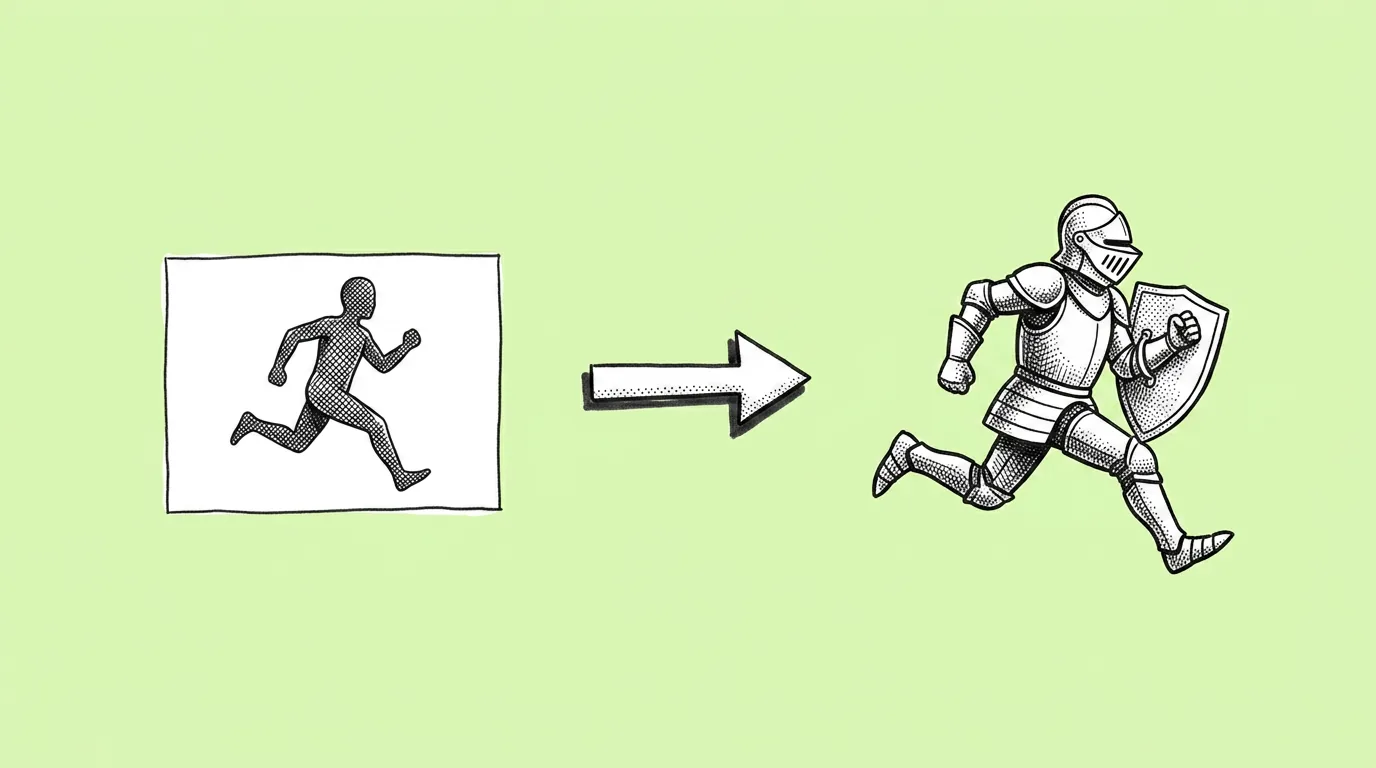
| The attached image | A pose reference with a clear silhouette: a photo, a 3D mannequin or a quick sketch. | A photo of someone mid-jump, arms up |
| [character name] | Call your character with @. | @Knight Aria |
When do you use a pose reference?
When "jumping" isn't specific enough. A UA creative built around one heroic moment, a key art composition the art director already sketched, a social post that copies a trending pose. Describing those in words takes three reruns. Showing the pose takes one.
What breaks, and how do you fix it?
The character copies more than the pose: the reference's body type, clothes or style come along. And complex poses tangle limbs.
- Use a reference with a clear silhouette. Arms and legs that don't overlap the body read best.
- Add a short text description of the pose. "Right arm raised, left leg forward, looking over the shoulder" tells the model what to take.
- Test a couple of models if anatomy breaks. Some handle unusual poses much better than others. Compare image models runs them side by side.
Variations to try
Use the attached image as a pose reference and apply it to @[character], standing on a cliff edge at sunset.
Apply only the pose from the attached image to @[character]. Ignore the clothing, body type and style of the reference.
FAQ
Can I use a photo of a real person as the reference?
+
Yes, as a pose guide. The prompt asks for the pose only, and adding "ignore clothing and body type" keeps the person's look out of the result.
Does it work with non-human characters?
+
Mostly. Animals and creatures with different proportions work best with a short description of how the pose maps to their body.
What's the best reference format?
+
A clean, full-body image with the limbs clearly separated. Stick figures and mannequin renders work well.